


Transforming organ transplantation
HEMO2life gives organs and patients a second chance at life
Successful organ transplantation isn’t measured only by what happens in the operating room. It depends on the quality of the organ being transplanted—and how well it can function over the long term.
One of the biggest challenges occurs during the period when an organ is disconnected from the donor’s blood circulation and kept in storage until it is connected to the recipient. This critical window is known as cold ischemia. It is a major driver of serious complications.
Using HEMO2life®, an oxygenation solution in which M101 is a key component, during this stage has shown strong potential to meaningfully improve clinical outcomes and reshape what is possible in transplantation.
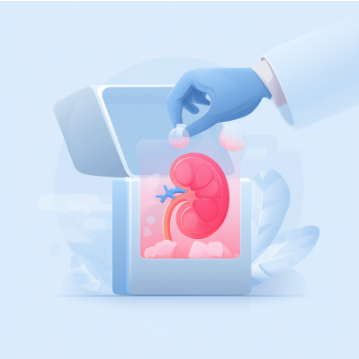
Giving organs a second life: HEMO2life® helps keep transplant organs healthy, functional, and ready to use—improving a patient’s chance of success
The key challenge: ischemia–reperfusion injury (IRI)
When an organ is removed from a donor, it immediately loses its oxygen supply. Even when stored in a cold preservation solution (around 4°C) to slow metabolism, cells can still suffer gradual damage over time.¹
The situation often becomes more severe at the moment of transplantation, when blood flow returns to the organ (reperfusion). This sudden re-oxygenation can trigger a strong inflammatory response and the release of large amounts of reactive oxygen species (free radicals), further damaging tissue that is already vulnerable.²
A major consequence is Delayed Graft Function (DGF)—a common and serious complication, especially in kidney transplantation. DGF means the new kidney does not start working right away, so the patient may still need dialysis after surgery. DGF is also directly linked to a higher risk of acute rejection and a shorter graft lifespan in the long term.³
The OXYOP clinical trial: real-world evidence you can point to
To evaluate how well HEMO2life® can address this problem, a large clinical study called OXYOP was conducted. It used a paired-kidney analysis, a powerful design where both kidneys from the same donor are used for comparison:
- One kidney was stored in a standard preservation solution.
- The other kidney was stored in the same standard solution, but supplemented with HEMO2life®.
This approach minimizes other variables and allows a much cleaner, more accurate comparison of the preservation solutions. The results from this landmark study—and its longer-term follow-up—were highly compelling:
- A significant reduction in DGF: Kidneys preserved with HEMO2life® showed a clearly lower rate of Delayed Graft Function compared with controls (7% vs 26% in some subgroups).⁴
- Faster recovery of kidney function: Additional analyses, including comparison with a large kidney-transplant patient database (ASTRE database), confirmed that recovery in the HEMO2life® group was significantly better, regardless of cold ischemia time—suggesting the benefit comes directly from the solution itself.⁵
Better long-term patient survival: The most striking finding came from 4-year follow-up data: patients receiving kidneys preserved with HEMO2life® had a survival rate of 98.3%, compared with 86% in the control group—a statistically significant difference (p = 0.016).⁶

Successful transplantation with HEMO2life® gives patients the chance to return to a better quality of life
These real-world successes in transplantation have already shown something powerful: delivering oxygen directly to oxygen-starved tissue can be the difference between failure and success. HEMO2life® doesn’t just reduce complications and improve patient survival—it also provides the strongest practical proof so far of the safety and effectiveness of M101 when used with human organs.
But if this technology can protect and “keep organs alive” so effectively outside the body, what becomes possible if we can bring the same capability inside the body, directly?
This is where we move from the present into the future—from being seen as a “blood substitute” to an exciting new frontier: therapeutic oxygen delivery, designed to help fight many other serious conditions.
Work cited
-
Thuillier, R., et al. (2011). Novel strategies to reduce ischemia-reperfusion injury in kidney transplantation. Transplantation Reviews, 25(2), 77-85.
-
Carden, D. L., & Granger, D. N. (2000). Pathophysiology of ischaemia-reperfusion injury. Journal of Pathology, 190(3), 255-266.
-
Yarlagadda, S. G., et al. (2009). Delayed graft function and the risk of allograft failure: a close look at the large picture. Transplantation, 87(6), 878-884.
-
Le Meur, Y., et al. (2020). First-in-human use of a marine oxygen carrier (M101) for organ preservation: A safety and proof-of-principle study. American Journal of Transplantation, 20(6), 1729-1738.
-
Kerforne, T., et al. (2021). HEMO2 life® improves renal function independent of cold ischemia time in kidney recipients: A comparison with a large multicenter prospective cohort study. Clinical Transplantation, 35(12), e14488.
-
Giraud, S., et al. (2024). Long Term Results of the Use of the Oxygen Carrier M101 as an Additive to Organ Preservation Solution. International Journal of Cell and Tissue Engineering, Artificial Cells and Regenerative Medicine, 2(1), 2420001.