


The power of biomimicry
when 450 million years of evolution outperforms human engineering
Throughout this article series, we’ve traveled from the global blood shortage crisis to an extraordinary biological discovery—and toward a future where medicine could be transformed. But this story isn’t only about biotech innovation. It is also a powerful proof of a philosophy called biomimicry: the idea that solutions to humanity’s most complex problems may have been hidden in nature’s blueprint all along.
Lessons from past failures
Over the past several decades, repeated attempts to create “artificial blood”, or hemoglobin-based oxygen carriers (HBOCs), ended in failure time and time again.¹ The dominant approach at the time was bioengineering—trying to “force” mammalian hemoglobin (from sources such as cows or even humans) into doing a job it wasn’t designed to do. Scientists tried techniques like cross-linking hemoglobin molecules together or encapsulating them in synthetic materials to reduce toxicity.
But these efforts were like trying to repair a system that was never built for this purpose in the first place. The result was often an “unnatural” molecule that caused severe side effects—most notably vasoconstriction, a dangerous tightening of blood vessels that can be life-threatening. Multi-billion-dollar programs were eventually shut down because human engineering could not overcome the fundamental limitations of the starting molecule.
A paradigm shift: from “creating” to “discovering”
The story of Hemarina and M101 represents a complete change in mindset. Instead of trying to “build” a new molecule from what already existed, Dr. Franck Zal began by searching for a molecule that nature had already designed—perfectly—for a specific mission.²
He wasn’t looking for something that was “almost good” and needed heavy modification. He looked for an organism that had evolved to survive extreme oxygen deprivation itself: the lugworm, Arenicola marina.
Over 450 million years, evolution acted as the ultimate bioengineer—selecting and refining the lugworm’s hemoglobin until it gained the exact features needed for the job: a huge molecular size to help prevent leakage out of blood vessels, an extraordinary oxygen-carrying capacity, and even built-in antioxidant activity.³
In this case, the human role was not to be the “creator,” but the learner and the extractor—bringing into medicine something nature had already optimized.
Conclusion: humility in the face of nature
The journey from a marine worm’s blood to the transplant operating room offers a profound lesson. It reminds us that the greatest breakthroughs don’t always come from trying to control or defeat nature—but from pausing, observing, and learning from the intelligence that life has been refining for millions of years all around us.
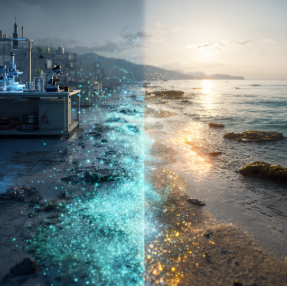
Biomimicry — learning from nature’s long evolution to create sustainable innovation for humanity
The success of M101 is not only a win for Hemarina. It is a win for the belief that nature is the greatest laboratory of all—and that when human engineering reaches its limits, evolution may already hold the answers, waiting to be discovered.
So we end this series with a simple hope: the next world-changing innovation might already be out there—deep in a forest, beneath the ocean, or even in our own backyard. All it takes is the willingness to look closely, stay curious, and learn from nature.
Work cited
-
Natanson, C., Kern, S. J., Lurie, P., Banks, S. M., & Wolfe, S. M. (2008). Cell-free hemoglobin-based blood substitutes and risk of myocardial infarction and death: a meta-analysis. JAMA, 299(19), 2304–2312.
-
Zal, F. (2022). The incredible story of the lugworm that could revolutionize medicine. TEDx Talks.
-
Rousselot, M., et al. (2006). Arenicola marina extracellular hemoglobin: a new promising blood substitute. Biotechnology Journal, 1(3), 333-345.