


Hermarina
from scientific curiosity to a sustainable biotech company
Even the greatest scientific discovery can mean very little if it can’t be translated into real-world benefit for people. The journey of M101—from the shoreline to the operating room—was made possible by one person’s vision and determination: turning scientific curiosity into a biotech company with a clear mission. This is the story of Hemarina.
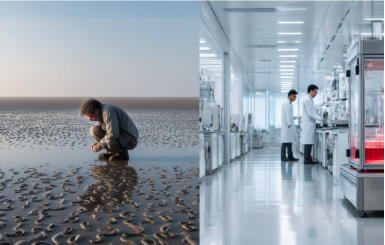
From curiosity on a beach to founding a biotech company ready to change the world
The beginning: from basic research to entrepreneurship
Hemarina was founded in 2007 by Dr. Franck Zal as a spin-off from more than 15 years of fundamental research he conducted at France’s National Center for Scientific Research (CNRS) and Sorbonne University. ¹ A world-leading expert in the respiratory pigments of marine invertebrates, Dr. Zal strongly believed that the lugworm’s hemoglobin could become a medical breakthrough—addressing urgent needs that had not yet been solved.
But the road was far from smooth. When he first presented the idea to the scientific community, reactions split into two camps. Some recognized it as the “molecule the world has been looking for for 40 years” while others remained skeptical—arguing that using a worm’s blood in humans sounded unrealistic, even crazy.²
Still, driven by his conviction in M101’s potential, Dr. Zal made the decision to establish Hemarina.
A smart strategy: starting with organ preservation first
Bringing a “blood substitute” to market—something that must be injected directly into the human body—is a long, complex journey. It requires massive funding and extensive clinical trials to prove both safety and effectiveness. Dr. Zal and his team therefore chose a smart, practical strategy: launch the first product in a field with urgent demand and fewer regulatory barriers—organ preservation for transplantation.³
That decision led to HEMO2life®, an oxygenation solution designed to be added to organ preservation fluids. This approach offered several key advantages:
- A faster path to market: As a medical device used outside the body (ex vivo), the approval process is generally less complex than a drug intended for direct injection.
- Revenue + proof of concept: The success of HEMO2life® helped generate revenue and—more importantly—provided real-world safety data for M101 in use with human organs, an invaluable foundation for future development.
- Lower risk for investors: A tangible product with clear medical impact builds confidence and makes it easier to attract investment for longer-term projects.

Hemarina’s smart strategy: Start with organ preservation to generate revenue and build real-world safety evidence—before moving toward a much bigger goal.
Sustainability: the heart of the business model
One of the first questions Dr. Zal faced was simple but critical: “Where can we source such a massive number of lugworms?” As a marine biologist, he understood immediately that harvesting worms from natural beaches to supply an industry would be unsustainable and could severely damage ecosystems.
That’s why Hemarina committed to a very different path: developing a dedicated land-based marine worm farm on Noirmoutier Island, France—reported as the world’s first farm to breed lugworms for medical purposes.⁴ This farm enables the company to:
- Fully control production: producing around 30 tons per year, ensuring a stable and sufficient supply of raw material.
- Guarantee quality: a closed farming system helps ensure consistent quality standards and reduces the risk of contamination.
- Operate sustainably: creating medical value without harming the environment—aligned with circular-economy principles.

A symbolic comparison between harvesting lugworms from nature (left) and Hemarina’s sustainable farming model (right).
From a simple question about a tiny creature on a beach, Hemarina has grown into a fully integrated biotech company—covering research, development, and sustainable in-house production of its own raw materials. This creates a strong foundation for future medical breakthroughs. However, smart business strategy alone doesn't measure Hemarina's success. It’s measured by what their solutions can achieve in the real frontline of medicine: the transplant operating room. Now it’s time to explore how their first go-to-market strategy—bringing HEMO2life® to hospitals—created real momentum and began reshaping organ transplantation, helping give organs (and patients) a true second chance at life.
Work cited
-
Hemarina. (n.d.). A human, scientific, and entrepreneurial adventure. Retrieved from hemarina.com
-
In:Expeditions. (n.d.). The first verse for health | Hemarina makes a discovery. Retrieved from inexpeditions.com
-
Rousselot, M., et al. (2006). Arenicola marina extracellular hemoglobin: a new promising blood substitute. Biotechnology Journal, 1(3), 333-345.
-
Hemarina. (n.d.). The aquaculture farm of Noirmoutier, breeding of marine worms. Retrieved from hemarina.com