


Beyond blood replacement
the future of therapeutic oxygen carriers
While solving blood shortages was the original goal, the real potential of M101—and the next-generation product HEMOXYCarrier® (an intravenous form)—goes much further. Thanks to its unique properties, including being smaller than red blood cells and able to release oxygen specifically where it is most needed, it is not just a “blood substitute.” It functions as a therapeutic oxygen carrier—a platform that could open doors to treatments that were previously out of reach.
Oncology: breaking through the tumor’s protective shield
One of the biggest challenges in cancer treatment is tumor hypoxia—a low-oxygen environment inside tumors. Fast-growing tumors often develop abnormal, poorly organized blood vessels, so the tumor core can become severely oxygen-deprived. This doesn’t just encourage resistance and metastasis; it also acts like a protective shield that reduces the effectiveness of treatments such as radiotherapy and some types of chemotherapy, because these approaches rely on oxygen to generate free radicals that damage cancer cells.¹
HEMOXYCarrier® can address this problem directly:
- Reaching where red blood cells can’t: Being up to 250 times smaller than a red blood cell, it can move through the tumor’s twisted microvessels and access areas that red blood cells cannot reach.
- Targeted oxygen release in low-oxygen zones: Once it reaches hypoxic regions, it can release oxygen, leading to re-oxygenation of the tumor environment—potentially increasing tumor sensitivity to radiotherapy and chemotherapy and improving treatment effectiveness in a meaningful way.²
Sickle cell disease: preventing vessel blockages before they start
Sickle Cell Disease (SCD) is a genetic condition in which red blood cells can change into a rigid, sickle-like shape when oxygen levels drop. These misshapen cells become stiff and sticky, blocking small blood vessels. This can trigger intense pain episodes known as vaso-occlusive crises (VOC) and can progressively damage vital organs.³
Preclinical studies using animal models of SCD have shown promising potential for M101:
- Administering M101 significantly reduced sickling of red blood cells and decreased hemolysis (the breakdown of red blood cells).
- Even more importantly, it helped prevent blood-vessel blockages in the liver and lungs—organs that are often severely affected in SCD.⁴
This suggests M101 could represent a new therapeutic direction: preventing pain crises at the source, rather than only treating symptoms after a crisis has already begun.
Stroke and heart attack: buying time and limiting damage
In emergencies like stroke or myocardial infarction (heart attack), every second matters—brain and heart tissue can die rapidly when oxygen is cut off. Giving HEMOXYCarrier® to a patient during transport to the hospital could act as an “oxygen bridge,” delivering oxygen to threatened tissue and buying precious time until definitive treatments can be provided—such as clot-busting drugs or procedures like angioplasty/stenting.⁵
Acute Respiratory Distress Syndrome (ARDS): a “molecular ventilator”
When the lungs cannot exchange gases effectively—such as in ARDS or severe COVID-19—even mechanical ventilation may not be enough to maintain adequate blood oxygen levels. In this context, an intravenously delivered oxygen carrier could function like a “third lung” or a molecular-level ventilator, rapidly raising oxygen delivery without relying on the damaged lungs. This could help support the body’s systems through the critical phase and improve the chances of survival.
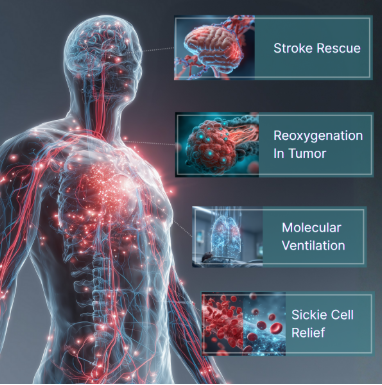
From “artificial blood” to “therapeutic oxygen carrier” — a technology that could reshape the future of medicine
The future of M101 and oxygen-carrier technology isn’t limited to filling blood-bank shortages. It represents a new medical frontier—where oxygen could be delivered to anywhere the body needs it, helping fight disease at the cellular level, from cancer to genetic disorders and critical emergencies.
This seemingly limitless potential comes from the unique properties of a single molecule—and it raises a powerful question:
How can a molecule from an ordinary marine organism solve problems that decades of advanced bioengineering have struggled to overcome?
The answer may not lie in “more technology,” but in a deeper principle behind this discovery: the power of biomimicry—when 450 million years of evolution outperforms human engineering.
Work cited
-
Brown, J. M., & Wilson, W. R. (2004). Exploiting tumour hypoxia in cancer treatment. Nature Reviews Cancer, 4(6), 437-447.
-
Batool, H., et al. (2021). Therapeutic Potential of Hemoglobin Derived from the Marine Worm Arenicola marina (M101): A Literature Review of a Breakthrough Innovation. Marine Drugs, 19(7), 376.
-
Kato, G. J., Piel, F. B., Reid, C. D., et al. (2018). Sickle cell disease. Nature Reviews Disease Primers, 4, 18010.
-
El Nemer, W., et al. (2024). Therapeutic potential of oxygen through M101 transportation in reducing vaso-occlusion and hemolysis in a mouse model of sickle cell disease. bioRxiv. [Preprint]
-
Ferenz, K. B., & Steinbicker, A. U. (2019). Hemoglobin-based oxygen carriers-quo vadis?. Anesthesiology, 131(5), 1143-1152.
-
Hemarina. (2020, March 23). CORONAVIRUS: HEMARINA'S MOLECULE CAN SAVE LIVES BY REPLACING LIFE-SUPPORT VENTILATORS FOR OXYGENATING PATIENTS WITH COVID-19. [Press Release].