


The world of blood
From real veins to synthetic solutions in the lab
When we hear the word “blood,” most of us picture a red liquid flowing through our veins—sustaining life, carrying oxygen, and keeping us alive. But in the world of modern science and medicine, blood means far more than that. It represents an entire frontier of innovation — from the centuries-long dream of creating artificial blood that can truly replace the real thing, to lifelike blood simulants that are now indispensable tools for researchers, students, and medical professionals.
This article explores the fascinating universe of blood in two very different dimensions — one that still belongs to the future, and another that’s already shaping the present.
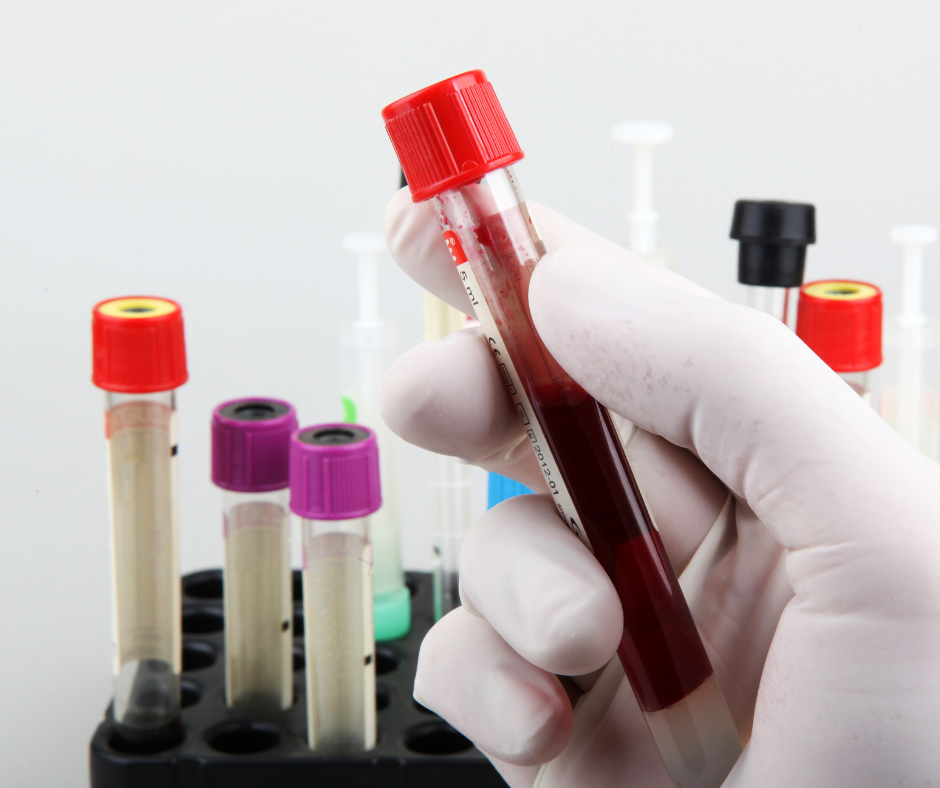
It’s Not Just Red Liquid
Universe I : The Long Journey Toward “Blood Substitutes” for Transfusion

For centuries, scientists have pursued one audacious goal — to create artificial blood that can be safely infused into the human body (in vivo) and save lives just like natural blood.
The quest began as a solution to critical medical problems: blood shortages, compatibility between blood types, and the risk of infection from donated blood.
Today, research into blood substitutes follows two main scientific paths.
1. Hemoglobin-Based Oxygen Carriers (HBOCs) : Decoding the Heart of the Red Blood Cell
This approach focuses on isolating hemoglobin—the key protein responsible for transporting oxygen—from red blood cells and chemically modifying it to function freely in circulation.
Sources of hemoglobin can range from expired human blood and bovine blood to recombinant production using genetic engineering.
- The Promise:
HBOCs are universally compatible with all blood types and can be stored for two to three years, compared to only 42 days for real blood.
- The Challenge:
Early HBOCs caused severe side effects such as vasoconstriction (narrowing of blood vessels).
When free hemoglobin roams outside the cell, it binds to nitric oxide (NO), a molecule that helps relax blood vessels. Without NO, vessels constrict, leading to high blood pressure and reduced oxygen delivery to vital organs.
- Now and Next:
Researchers are developing advanced HBOCs using nanotechnology to encapsulate hemoglobin within protective shells or by increasing molecular size to prevent NO scavenging.
The U.S. Defense Advanced Research Projects Agency (DARPA) is even funding large-scale projects to create “complete synthetic blood” — combining HBOCs, synthetic platelets, and plasma for battlefield use.
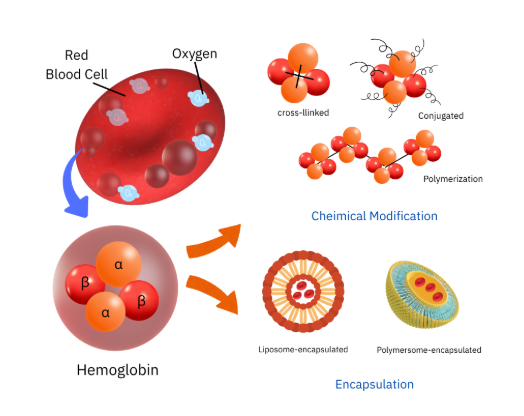
Research models of hemoglobin-based oxygen carriers (HBOCs).
(https://www.tandfonline.com/doi/full/10.2147/DDDT.S422770)
2. Perfluorocarbon Emulsions (PFCs):
A Chemical Marvel that Breathes Oxygen
While HBOCs modify biology, PFCs are purely synthetic compounds — inert, Teflon-like molecules that can dissolve oxygen up to 50 times better than plasma.
Instead of relying on biochemistry, PFCs physically carry oxygen through the bloodstream.
- The Promise:
Being fully synthetic, PFCs carry no risk of biological contamination and can be mass-produced. The first product, Fluosol, was once approved for limited clinical use.
- The Challenge:
PFCs require patients to breathe oxygen-rich air for optimal performance, and some users experience flu-like side effects.
- Now and Next:
Although no PFC product has yet received FDA approval, research continues worldwide—particularly in Russia and Japan—exploring their use in organ transplantation and ischemic tissue therapy.
In summary:
The pursuit of transfusion-grade artificial blood remains one of medicine’s most ambitious goals. HBOCs and PFCs represent critical steps, but both are still under active development and far from replacing natural blood.
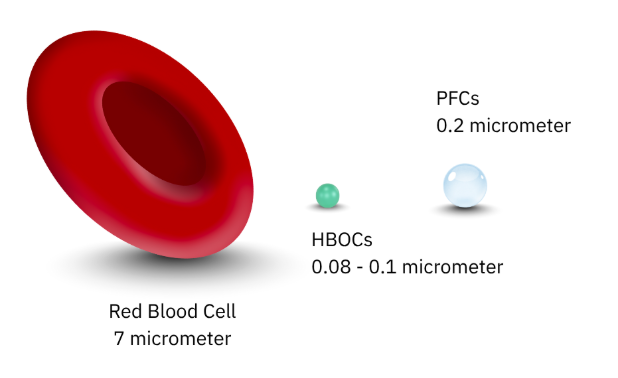
Both HBOCs and PFCs are significantly smaller than human red blood cells.
(https://www.researchgate.net/figure/Both-HBOCs-and-PFCs-are-considerably-smaller-than-red-blood-cells-1_fig2_304534029)
Universe II : “Blood Simulants” — The Tangible Success of Today
While true artificial blood is still a work in progress, another kind of synthetic blood has already achieved commercial success — blood simulants.
These materials aren’t meant to circulate inside the body. Instead, they are engineered to mimic the physical properties of human blood for external (ex vivo) use — especially in medical training and product testing.
Their realism depends on three key properties:
- Color – visually identical to real blood
- Viscosity – matching the thickness and flow behavior of human blood
- Surface tension – determining how easily the liquid spreads or penetrates materials
Most blood simulants are composed of water, thickeners (such as xanthan gum or PEG), pigments, and surfactants. While they can’t reproduce the cellular complexity of blood—such as immune reactions or true oxygen transport—they have become indispensable heroes in two major fields.
"In Thailand, our team has developed a standardized synthetic blood specifically designed for PPE testing and medical training. The formula replicates the color, viscosity, and surface tension of real human blood as closely as possible, and has been validated under the ASTM F1862 standard—ensuring that laboratories and manufacturers can rely on the accuracy and consistency of their test results."
1. Medical Training : Safe, Realistic Practice Before the Real Patient
Imagine a medical student practicing blood draws for the first time. A training arm filled with circulating red fluid provides a safe, realistic experience before they ever touch a real patient.
- Realism is key: Our team’s synthetic blood formula recreates the “flashback” — the moment blood appears in the needle hub — making practice sessions more authentic and confidence-building.
- Next-generation innovation: Some new simulants even coagulate on contact with special hemostatic gauze, forming semi-solid clots. This breakthrough allows trauma-care trainees to see whether their bleeding-control techniques truly work in real-time.
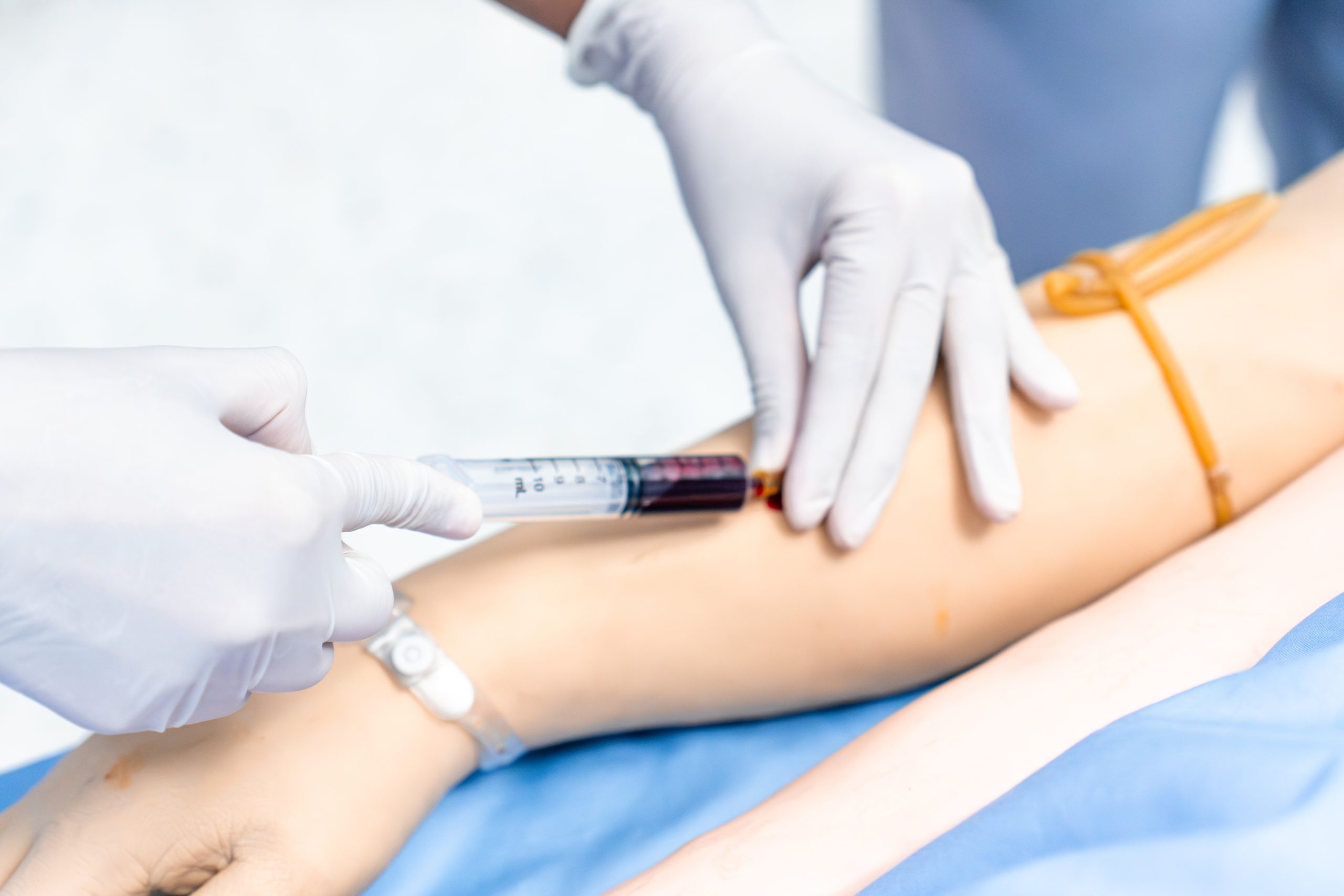
Realistic practice builds confidence — helping future healthcare workers stay calm when real emergencies strike
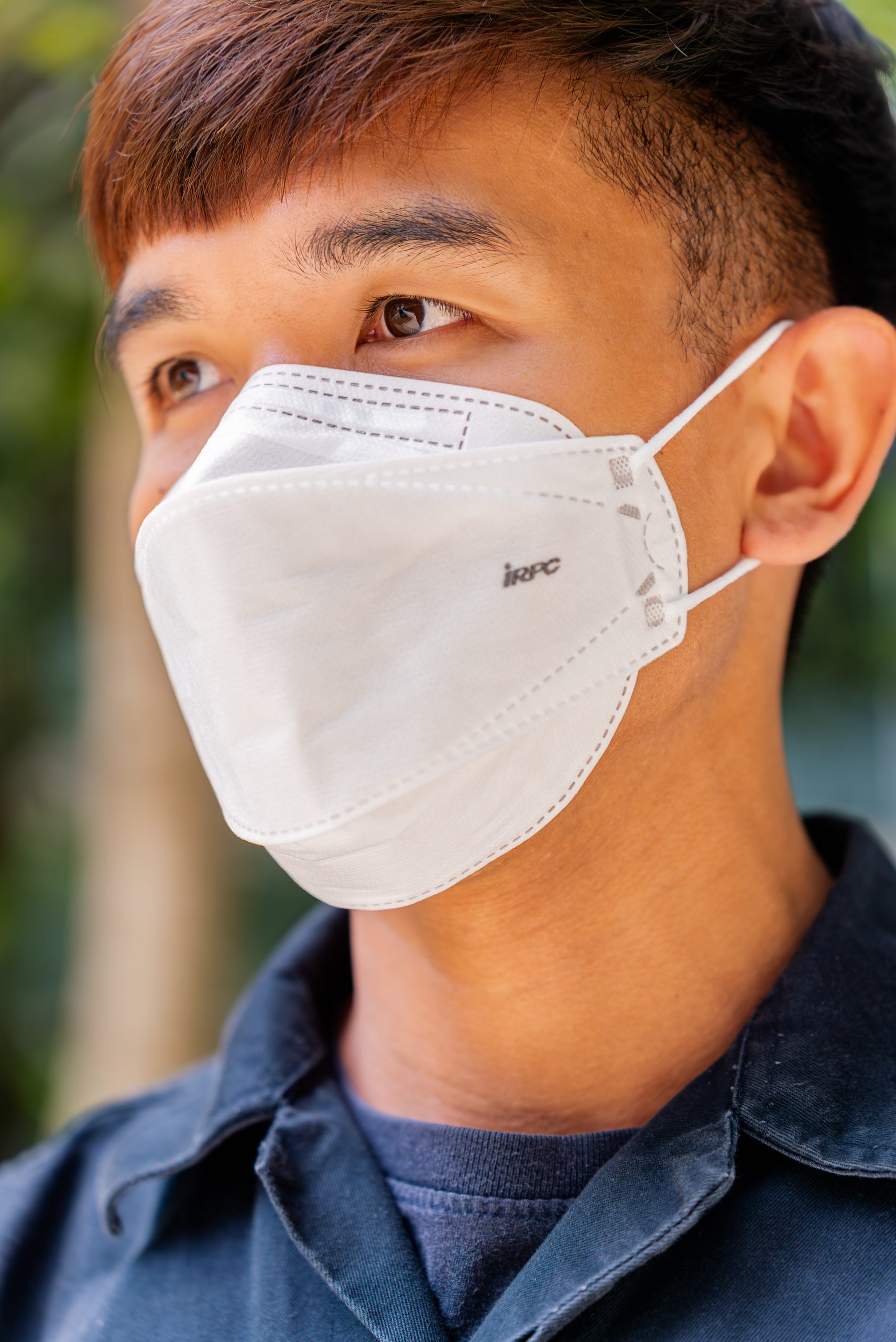
2. Testing Medical Protective Equipment : Guardians of Frontline Safety
Another vital use of synthetic blood is in testing medical face masks and protective gear under international standards like ASTM F1862.
The test involves propelling a small amount of synthetic blood at high speed toward a mask to simulate splashes during surgery or emergencies.
Why not just use colored water?
Because blood has a lower surface tension than water, allowing it to seep through micro-pores more easily. Using plain red water would produce false results — potentially approving unsafe masks.
That’s why the test fluid must be standardized synthetic blood with carefully controlled properties, ensuring consistent, reproducible safety validation.
It’s the testing standards that allow us to truly trust the quality and safety of what we use.
Why Not Use Real Blood?
Using real donated blood for testing or training may seem straightforward, but synthetic blood simulants have clear advantages:
- Safety: No risk of infection or biohazard exposure.
- Consistency: Real blood varies widely among donors and deteriorates over time; simulants remain stable and uniform.
- Convenience and cost: Non-hazardous, easy to dispose of, and much cheaper than handling bio-waste.
- Shelf life: Synthetic blood lasts longer and is always ready for use.
Our standardized simulant matches the surface tension defined by ASTM F1862 and ISO 22609, ensuring accuracy and repeatability in PPE testing — reducing the risk of unsafe products slipping through unnoticed.
Final Thoughts
The world of blood in science is far broader and more exciting than we might imagine.
It spans two distinct universes:
- the futuristic realm of blood substitutes still under development, and
- the practical, real-world success of blood simulants already protecting healthcare workers and training tomorrow’s professionals.
So, next time you see a medical training video or a mask-testing lab, remember — behind those quiet scenes of progress lies synthetic blood, the silent hero driving innovation and safety forward in modern medicine.
"The development of our synthetic blood combines materials science expertise with international testing standards to create a truly practical solution — one that can be applied in hospitals, medical institutions, and PPE manufacturing facilities. Our goal is to help Thailand achieve world-class standards in safety and medical training."
Work cited
- เลือดเทียมมีจริงหรือไม่ - SciMath, accessed August 5, 2025
- Artificial blood - PMC, accessed August 5, 2025
- Veterinary Perspectives on Hemoglobin-Based Oxygen Carriers in Experimental Hemorrhagic Shock: Insights from Rabbit Models - MDPI, accessed August 5, 2025
- Horizon Scan of the Artificial Blood Research and Funding Landscape - NIHR Innovation Observatory, accessed August 5, 2025
- Nanomaterial-related hemoglobin-based oxygen carriers, with emphasis on liposome and nano-capsules, for biomedical applications: current status and future perspectives - PubMed, accessed August 5, 2025
- นักวิจัยญี่ปุ่นคิดค้น 'เลือดเทียม' ใช้ได้กับทุกกรุ๊ปเลือดแก้ปัญหาขาดแคลน - Spacebar.th, accessed August 5, 2025
- Banking on Artificial Blood | ASH Clinical News | American Society of Hematology, accessed August 5, 2025
- Hemoglobin-based oxygen carriers, oxidative stress and myocardial infarction - Frontiers, accessed August 5, 2025
- Synthetic Blood (เลือดเทียม), accessed August 5, 2025
- Synthetic Blood - Pickering Test Solutions, accessed August 5, 2025
- Overcoming Challenges and Solutions in Phlebotomy Simulation Training, accessed August 5, 2025
- Professional Blood Moulage - Tips For Healthcare Educators & Simulationists - theSimTech, accessed August 5, 2025
- หน้ากากเจาะเลือดสังเคราะห์ - การทดสอบหน้ากากทางการแพทย์ - IDM ..., accessed August 5, 2025
- Is Your Surgical Mask Protecting You? What You Don't Know May Hurt You | HALYARD, accessed August 5, 2025
- Synthetic Blood for PPE Testing - Kinectrics, accessed August 5, 2025
- Mask & Surgical Gown Testing | Kinectrics, accessed August 5, 2025
- ASTM F1862 / F1862M-17 วิธีทดสอบมาตรฐานสำหรับความต้านทานของมาสก์หน้าทางการแพทย์ต่อการเจาะโดยเลือดสังเคราะห์ (การฉายภาพในแนวนอนของปริมาณคงที่ด้วยความเร็วที่ทราบ) - Denetim, accessed August 5, 2025
- การทดสอบการควบคุมหน้ากาก - EUROLAB, accessed August 5, 2025
- ASTM F1862/F1862M-13 - Standard Test Method for Resistance of Medical Face Masks to Penetration by, accessed August 5, 2025
- The Surface Tension of Synthetic Blood used for ASTM F1670 Penetration Tests - PMC, accessed August 5, 2025